Plinko looks like a physics toy. A ball, a field of pegs, a row of buckets at the bottom, and a number under each bucket that decides what you get paid. The presentation suggests chaos, and chaos is the point of the animation. Underneath it there is no chaos at all. A sixteen row board is sixteen independent left-or-right decisions, which is sixteen coin flips in a trench coat, and sixteen coin flips have a distribution that was fully described centuries before anyone put a multiplier under it. Build that distribution yourself and the payout table stops looking like a designer’s opinion. It starts looking like the only table that could have been printed.
Sixteen rows, sixteen coin flips
Every time the ball meets a peg it goes left or right with equal probability, and the pegs have no memory of each other. Sixteen rows, sixteen decisions. The bucket at the bottom is determined by one number: how many of those sixteen went right.
That count can be anything from zero to sixteen, which is why the board has seventeen buckets rather than sixteen. The number of distinct paths ending in a given bucket is the binomial coefficient C(16, k), and the total number of paths across the whole board is 2 to the sixteenth, or 65,536. Probability of any bucket is just its path count divided by 65,536.
Two things follow immediately. The distribution is symmetric, because a path and its mirror image are equally likely. And it is not remotely flat, because there is exactly one way to go right sixteen times and there are thousands of ways to go right eight times out of sixteen.
Why the middle bucket eats most of the balls
Counting the paths bucket by bucket takes about a minute, and it explains the shape of Plinko better than any amount of description of the pegs. Here is the whole board:
- Dead center, eight lefts and eight rights: 12,870 paths, which is 19.6% of everything.
- One bucket either side of center: 11,440 paths each, 17.5%. There are two of them, so as a pair they swallow more balls than the center does.
- Two out: 8,008 paths, 12.2%.
- Three out: 4,368, call it 6.7%.
- Four out: 1,820 paths. 2.8%, and this is roughly where a casual session stops producing hits.
- Five out: 560 paths, 0.85%.
- Six out: 120 paths, 0.18%.
- Seven out: sixteen paths, 0.024%.
- The outermost bucket on either end: one path. One. Sixteen decisions all going the same way, 1 in 65,536, or about 0.0015%.
Add the middle five buckets together and you get 51,766 paths out of 65,536, which is 79%. Four balls in five land in the flat boring center of the board. That is not the operator being stingy with the animation. That is what sixteen coin flips do, and it would do it on a wooden board in your garage.
Reading the payout table as a probability table
Now put the two columns side by side. Probability per bucket on the left, multiplier per bucket on the right. Multiply across each row, then add the products. That sum is the expected return on one unit staked.
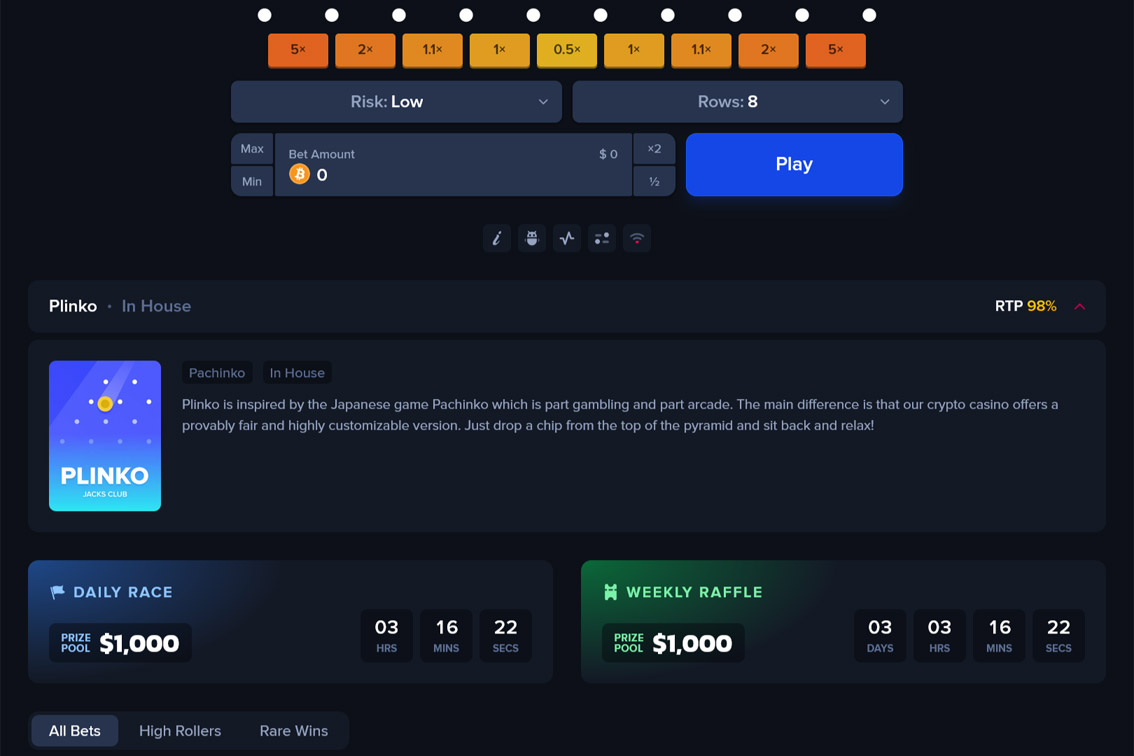
Jacks Club publishes 98% RTP on Plinko, which is a 2% house edge stated from the other end. So that sum comes to 0.98. Not 0.99, not 1.02, and not a number that drifts with how the last hundred balls fell. It is a design constraint the table was built to satisfy.
Which tells you something useful about reading any multiplier. A number under a bucket is never generous or stingy on its own. It’s generous relative to how often the ball lands there. A 5x on a bucket that fills 12% of the time is doing far more work in that sum than a 1000x on a bucket that fills once in 65,536 drops, and once you can do that multiplication in your head, the table stops being able to impress you.
Risk level does not change the edge, it changes the shape
The risk selector is the part people misread most. Switch to high risk and the multipliers at the edges climb steeply while the center multiplier drops below 1. Switch to low and the whole curve flattens out toward the middle.
What does not move is the 2% edge. The paytable is rescaled to hold RTP at 98% whichever setting you pick, because the products still have to sum to 0.98. High risk is not a better bet or a worse one. It is the same bet with the outcomes redistributed.
What changes is variance, and variance is what you actually feel. On high risk, that 79% of balls landing in the middle five buckets is now landing on multipliers under 1, so the common outcome is a small loss, over and over, funded by tail events you are waiting on. Low risk pays you back something close to your stake most drops and almost never surprises you. Same price, different ride, and the only real question is which one you can sit through without changing your bet size.
The 1000x bucket and what it is actually worth
The headline multiplier on a high risk sixteen row board sits in the outer bucket. Price it honestly.
Each outer bucket carries probability 1/65,536. There are two of them. Their joint contribution to expected return is 2 times 1000 divided by 65,536, which works out to 0.0305. Set that against the full 0.98 and the pair accounts for about 3.1% of everything the table ever pays back.
Read that the other way and it gets interesting. Roughly 3% of the money coming back to players flows through an event that most players will never trigger. Your realized return over any normal session is therefore systematically below the posted figure, not because the number is wrong, but because you are sampling a distribution whose mean is propped up by an outcome you almost certainly will not see. The mean and the median are different animals here, and the table advertises the mean.
The one thing the tail is not is a mystery. Because Plinko is an in-house original, each drop runs on a provably fair system, and the path is reproducible afterward from the server seed, your client seed and the nonce. You can confirm that the sixteen decisions were the sixteen decisions the seeds dictated. What you cannot do is make them land anywhere in particular.
Running the numbers on a hundred drops
Say you drop a hundred balls at one unit each. A hundred units through the board, 98% RTP and a 2% edge, so the expected return is 98 units and the expected cost of the session is 2 units. That is the whole arithmetic of what you are paying.
Expected landings in the center bucket: 19.6% of 100, so about 20 balls. You will see the middle constantly.
Expected landings in an outer bucket: 100 divided by 65,536, which is 0.0015 balls. Put as a probability, the chance of hitting one at least once across the hundred is about 0.15%, near enough one session in 655.
And the number that ends most arguments about being due: drop 65,536 balls, one for every path on the board, and your chance of never once hitting a specific outer bucket is still about 37%. More than a third of players who go the full distance come away having never seen it. The board doesn’t keep a ledger.
None of this makes the next ball land anywhere in particular. It does mean that when it drops into the middle again, you’ll know that was the likeliest thing that could have happened, and you’ll know exactly what the drop cost you before you pressed the button.